
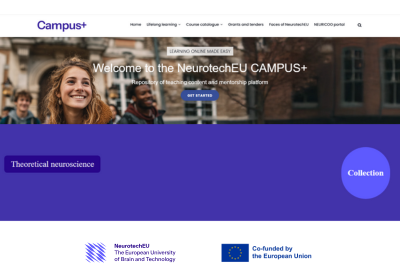
Campus +, the Theoretical Neuroscience dimension courses
Neurotechnology is the eight-dimension area of study and research that The European University of Brain and Technology –NeurotechEU, is focused on. One of its dimensions is Theoretical neuroscience, this dimension aims to unify the fundamental principles of neural organisation, creating a solid foundation for empirical evaluation and technical development.
However, knowledge is only useful if it’s shared and improved, that’s why the NeurotechEU platform Campus + collects different courses on the empirical and clinical neuroscience. This dimension relies on the continuous advancements in neuroscience technologies, leading to an exponential increase in data generation. You can read more about it on Campus +.
Courses regarding the Theoretical Neuroscience dimension:
- Including seven lessons, this intermediate-level course will teach students how to work with calcium-imaging data. The main objective of this course is to reduce irrelevant background signal and to identify the neurons' cell bodies in the images.
- Functional Magnetic Resonance Imaging (fMRI) is a neuroimaging technique that measures brain activity by detecting blood flow and oxygenation changes. With a seven lessons course, participants will learn about the blood-oxygen-level dependent (BOLD) contrast signals, trial-averaging, and t-tests fMRI’s techniques.
Research Methodology – Statistics:
- This two-lesson course will guide participants through the essential concepts of Statistical reasoning that ensure the scientific validity and interpretability of clinical research. The coin-flip model, the null hypothesis, P-values, and the common pitfalls in interpreting statistical significance are some of the concepts introduced in this expert-level course.
What is Campus+?
The NeurotechEU platform, Campus+ serves as a dynamic repository of teaching content, offering a collection of courses from all NeurotechEU partner institutions. With contributions from eight universities, the platform ensures that learners gain access to cutting-edge content across diverse fields of neurotechnology. It also acts as a mentorship hub, connecting students with experts in their disciplines, facilitating knowledge transfer, and nurturing innovation.