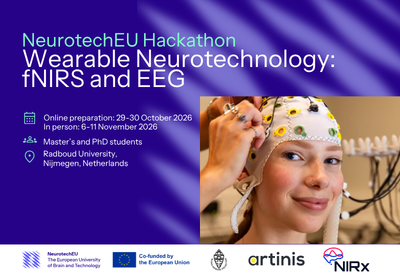
NeurotechEU Hackathon Wearable Neurotechnology: fNIRS and EEG
About
Wearable neurotechnology is increasingly used in neuroscience, rehabilitation, human factors research, neuro-ergonomics and brain-computer interfaces. Among the most widely adopted wearable methods are Electroencephalography (EEG) and Functional Near-Infrared Spectroscopy (fNIRS).
In this hackathon, you will work in a group to design new applications for these techniques. You will also receive lectures that introduce both techniques from physiological principles to practical application. You will learn how brain activity can be measured through electrical and haemodynamic signals and how the two modalities.
Working in interdisciplinary teams, students are challenged to answer a practical question and design a new application using wearable neurotechnology and to demonstrate, through experimentation and data analysis, how EEG, fNIRS, or a combination of both could provide a meaningful solution.
The hackathon follows a complete neurotechnology workflow:
- Understanding EEG and understanding fNIRS
- Designing an experiment, based on a real-world problem
- Acquiring wearable neuroimaging data
- Processing and analysing data
- Interpreting findings
- Evaluating multimodal approaches
Presenting scientific results
Learning outcomes
After completion, participants will be able to:
Knowledge
- Explain the physiological principles of EEG and fNIRS.
- Compare strengths and limitations of both modalities.
Skills
- Design a wearable neurotechnology application.
- Acquire high-quality EEG and fNIRS recordings.
- Assess signal quality and identify artefacts.
- Analyse EEG and fNIRS data using open-source tools.
- Evaluate the suitability of different neurotechnology solutions.
Professional Competences
- Translate a real-world challenge into a new application
- Work effectively in interdisciplinary teams.
- Develop an evidence-based neurotechnology concept.
- Pitch scientific and technological solutions to a larger audience.
Details
Format: Erasmus+ Blended Intensive Program
Duration: Online preparation (29-30 October 2026); In person Friday, 6 - Wednesday, 11 November 2026
Credits: 3 ECTS
Organisation: academic staff from Radboud University, Boğaziçi University and Medical University of Innsbruck; and staff from the companies Artinis Medical Systems BV and NIRx Medical Technologies
Eligibility and application
Master's and PhD students from a wide range of academic backgrounds are encouraged to apply. Working in interdisciplinary teams is a key part of the experience, providing opportunities to learn from different perspectives and areas of expertise.
Please note that only students currently enrolled at one of the following universities are eligible:
- NeurotechEU partner universities (Radboud University, Universidad Miguel Hernández de Elche, Karolinska Institutet, Rheinische Friedrich-Wilhelms-Universität Bonn, Boğaziçi Üniversitesi, Universitatea de Medicină și Farmacie din Cluj-Napoca, Université de Lille, Háskólinn í Reykjavík, Medizinische Universität Innsbruck)
- Universities in the NeurotechEU network (Western University, Lithuanian University of Health Sciences, University of Debrecen)
Places are limited. The nomination deadline is 12 October. Students must apply through their home university. Please note that individual universities may have internal application deadlines that are earlier than the nomination deadline, so students should check local requirements and submit their application as soon as possible.
The Hackathon is part of the NeurotechEU General Assembly. During the Hackathon, you will have the opportunity to participate in several parts of this event.
Should you have any questions, please address them to Gemma van der Sluijs at gemma.vandersluijs@donders.ru.nl.